
Dire Straits
- Bob O'Brien

- 1 day ago
- 3 min read
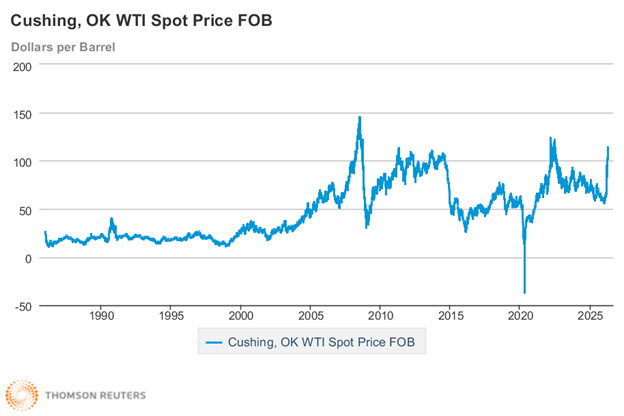
Dire Straits is an English rock band. In common English, the phrase refers to being in a very difficult or desperate situation. These days you’d be forgiven to think that the phrase could also refer to the Strait of Hormuz, which is between the Gulf of Oman and the Persian Gulf. The current situation has certainly been “difficult,” and some have said “desperate.” However, at this time, we would say that, from a historical point of view, that the worry about high oil prices is an overaction.
Let’s start by looking at history. In the chart above, we show the closing cash price in Cushing, Oklahoma. Our first observation would be that extremely high prices have never lasted all that long.
In July of 2008, crude oil reached a high of $145.16 per barrel before it crashed (along with the stock market) to a low of $30.28 five months later on December 3.
In February 2014 Russia invaded Crimea. Cash prices reached a high of $105.34 on March 3, but fell nine months later in December to the $56 level.
On January 3, 2020, crude oil was trading around $63, only to crash during the Covid scare to a negative $36.98 just four months later on April 20.
On March 8, 2022, during the beginning stages of the Russian invasion of Ukraine, crude oil prices reached a high of $123.64. Nine months later, prices had fallen on December 9 to $71.05
The most recent oil price surge started with the U.S. and Israel’s war against Iran. Just ten days ago, oil prices reached a high of $114.58 (April 7). As we write today, oil prices are trading near $83.00 in a wild fluctuating market. With peace possibly breaking out all over the Middle East, we would not be surprised to see oil prices fall further to the $70.00 level within another week or two.
Our second observation is that from an inflation point of view, even at today’s high price, crude oil prices are relatively cheap. Adjusted for inflation, the July 2008 all-time high price of $145.16 would be close to $218.00 per barrel. Today’s cash price is less than 50% of that inflation adjusted level.
What’s behind the historical sharp price declines from very high levels? We’d say it’s the simple supply and demand factors that you learn in high school Economics classes. When commodity prices reach very high prices, demand falls and supply increases. It’s been happening now again this year in reaction to the price surge following the U.S. Iran war.
In regard to a decline in demand, we point out the following examples:
Australia and South Korea have urged its citizens to conserve by stop driving their cars and ride public transportation instead. More importantly, South Korea and India are switching to coal instead of using oil for energy production.
In regard to increased supply, we point out the following examples:
Sable Offshore Corp. has resumed oil sales through the Santa Ynez Pipeline System in Santa Barbara County, which has been idle since 2015. Meanwhile, Continental Resources, America’s largest privately held oil and natural gas company, is increasing its oil production.
Syria’s government is moving to restore the Kirkuk-Baniyas oil pipeline with Iraq. Due to the long Syrian civil war, it has been shut down since the early 2000s.
ExxonMobil‑led producers in the South American country of Guyana, which had been previously threatened by Venezuela before President Trump acted, have reached a “significant milestone” in current oil production, and have ambitious plans to substantially increase its production.
Saudi Arabia and the United Arab Republic have used other means to avoid the Strait of Hormuz to ensure that their oil production is not blocked and that their oil supply can safely be exported.
Who knows what will happen over the weekend in the volatile Middle East, but it looks like to us that Trump’s blockade of Iranian exports is pressuring the radical religious fanatics that still control Iran to make further concessions. Also, missed in all of the focus on Iran is that the United States military is fully withdrawing from Syria after ten years. Maybe peace is starting to spread, and a grand bargain with Iran will break out over the weekend. If so, we will get another sharp decline in oil prices - just like has happened in the past.
Check out the links below⬇️⬇️
https://www.zerohedge.com/energy/gulf-states-considering-network-new-pipeliness-bypass-strait-hormuz


Comments